 Skip to content

Ana sits in her Fort Worth kitchen after school drop-off, staring at a stack of papers and wondering where custody gets decided. She knows she needs an order that protects her kids and gives the routine some stability, but the courthouse process feels like a maze before she's even filed anything. If that sounds familiar, the Tarrant County 233rd District Court custody case process becomes much easier to follow once you see the steps in order.
The 233rd District Court is one of Tarrant County's family courts, and for many parents, it's the courtroom that will handle their custody or parent-child case in Fort Worth. The path usually starts with a petition, moves through service and temporary orders, then turns to discovery, mediation, and a final hearing. Some cases also involve a custody evaluation through Tarrant County Family Court Services, which adds its own timing and disclosure rules under the county's guidance.
Table of Contents
- Starting a Custody Case in the 233rd District Court
- Filing the Petition and Serving the Other Parent
- Temporary Orders Hearings in Tarrant County
- Discovery, Mediation, and ADR in the 233rd
- Preparing for the Final Hearing or Trial
- Modifications, Temporary-Orders Changes, and Support Reviews
- Enforcement, Contempt, and Long-Term Planning
Starting a Custody Case in the 233rd District Court
Ana's first question is the one most parents ask at home before they ever call the clerk, “Is this the right court?” In Tarrant County, the 233rd District Court is a family district court serving Fort Worth and surrounding North Texas families, and the court is housed in the Family Law Center at 200 East Weatherford Street, Fort Worth, Texas 76196 on the 5th floor. The county lists the judge's line at 817-884-1794 and the associate judge's line at 817-884-1197, which tells you this is a real downtown Fort Worth courthouse process, not a remote filing-only system. Tarrant County's court directory also places the court inside the county family-court system, which matters when you're searching for the right place to file.
What kind of case goes here
A custody case in Texas is often filed as a Suit Affecting the Parent-Child Relationship, or SAPCR. That's the case type parents use when they need the court to decide conservatorship, possession, access, child support, or other parenting issues under Texas law. Parents usually file because they're unmarried, they're divorcing with children, or they need to change an existing order.
Jurisdiction and venue matter too. In plain English, the child generally needs to have lived in Texas for six months before Texas becomes the right state to decide the case, and Tarrant County has to be the proper county for filing based on the family's circumstances. If you're not sure whether your case belongs in Tarrant County at all, or whether another county should hear it first, that's the kind of threshold question that deserves individualized legal advice.
Practical rule: if you're deciding between filing, modifying, or asking for temporary relief, the label on the case matters as much as the facts in the case.
For readers who want a courthouse overview, this Fort Worth custody courthouse guide is a useful starting point for understanding where local family cases are heard.
Filing the Petition and Serving the Other Parent
The filing stage is usually less dramatic than people expect, but it still has to be done carefully. At the Family Law Center on Weatherford Street, a parent typically begins by preparing the Petition in Suit Affecting the Parent-Child Relationship, the required information sheet, and any local standing-order paperwork that applies to the case. From there, the case can be filed through the Tarrant County eFileTexas system or in person at the courthouse.
The first paperwork has to match the case you're filing
A parent filing for initial custody relief needs to be clear about what the court is being asked to decide. If the issue is a new parenting order, the petition should match that request. If the issue is changing an existing order, the filing needs to fit the modification track instead of looking like a brand-new parent-child case.
The cost of filing is often around $350, depending on the petition type, though parents who qualify may ask for a fee waiver. If money is tight, that request can matter, but it must be supported properly. A waiver isn't automatic just because the filing feels urgent.
After filing, the next step is service. The other parent must receive legal notice through a constable, certified mail when allowed, or a private process server. Once served, the respondent generally has to answer by 10:00 a.m. the Monday after the 20-day answer period. That deadline trips people up because it sounds more flexible than it is.
Here's the part many parents miss:
- File the right case first. The court can't fix a petition that asks for the wrong type of relief.
- Serve correctly. A case doesn't really move until the other parent has been properly notified.
- Track the answer deadline. Missing it can change how the case is set for hearing.
Tarrant County also uses initial disclosures in family cases, and later motions usually require a Certificate of Conference. That means the court expects parents and counsel to talk before dropping every dispute in front of a judge.
Temporary Orders Hearings in Tarrant County
Sometimes a parent can't wait for the final order. A child needs a stable school routine now, or a parent is worried the other side may move the children before trial. In those situations, the 233rd District Court may hear a request for temporary orders, which can shape the case while it's still pending.
What a judge may decide before trial
Temporary relief often starts with a sworn request, such as a verified motion or petition for temporary orders. If there's an immediate concern, a parent may also seek a Temporary Restraining Order or Temporary Injunction under the rules that apply to urgent family disputes. Notice matters here. The court generally expects the other side to receive notice before the temporary hearing unless a specific emergency procedure justifies a shorter path.
At the hearing, the court may decide who has primary possession, whether a geographic restriction applies, and whether temporary child support should be paid while the case is pending. A judge may also issue injunctions to stop conduct that would complicate the case, including moving children out of state or dissipating assets while the court is still gathering facts.
A common Fort Worth example is a parent who says, “I got a job in Austin and want to move next month.” That request is not just about a new address. It raises school continuity, possession logistics, and whether the move fits the child's best interests. Another common example is a parent who starts a new relationship and worries the other side will argue that the new household is unstable. The court doesn't decide the case based on labels or assumptions, it looks at the actual child-focused facts presented at the hearing.
Plain-English takeaway: temporary orders are not the final answer, but they often decide the daily reality of the case while everything else is still being fought over.
Discovery, Mediation, and ADR in the 233rd
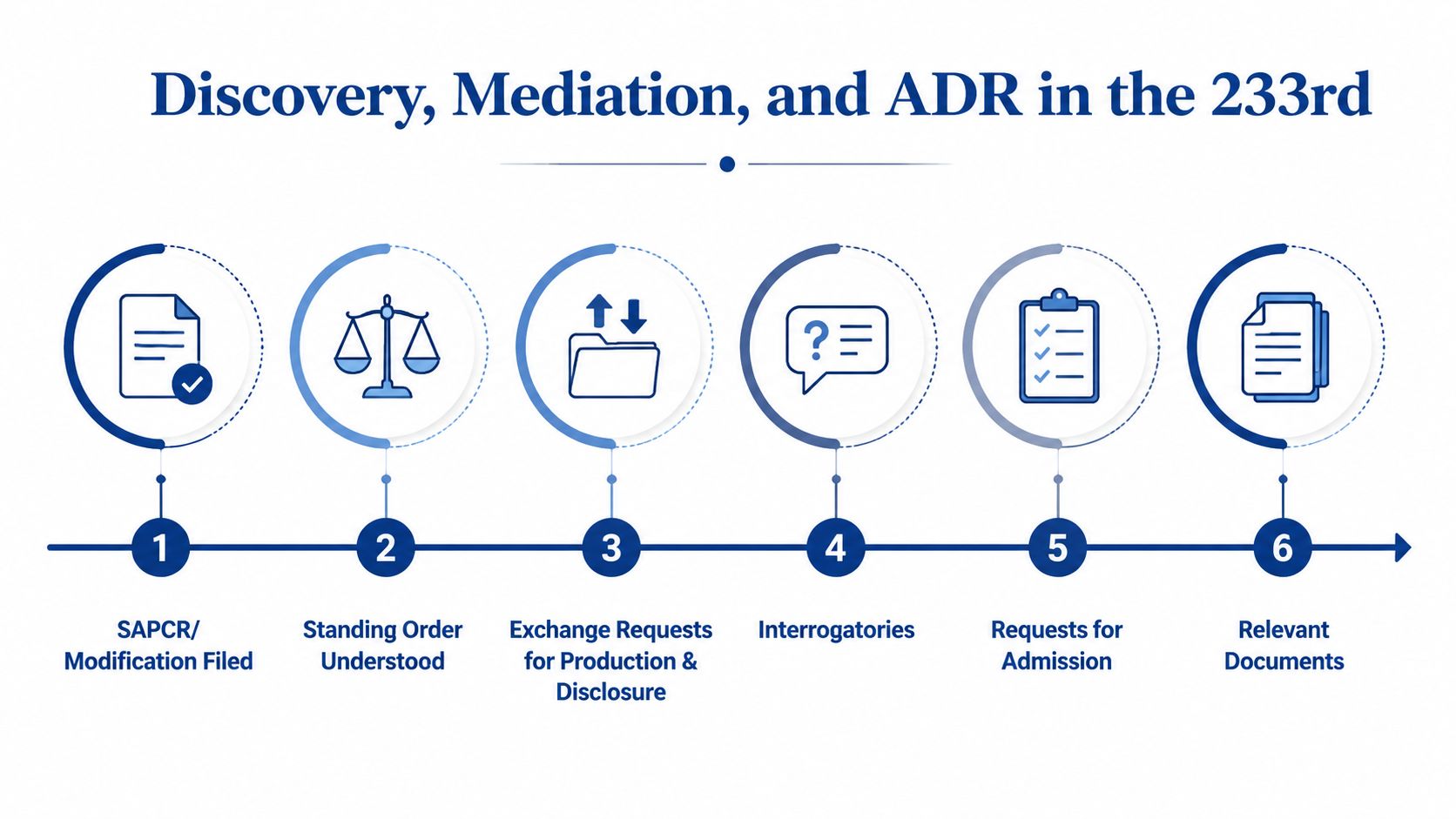
Discovery is the part of the case where each side has to show its cards. In a custody dispute, that usually means disclosures, interrogatories, requests for production, and requests for admission. It can also reach school records, medical records, therapy records when relevant, and communication records that show how the parents have handled schedules, exchanges, and child-related decisions.
Preserving records the right way matters
If social-media posts matter to the case, save them completely. Keep the screenshot, the date, the URL if you have it, and enough surrounding context to show what the post meant in the larger conversation. Shortened or edited snippets usually create more problems than they solve.
The 233rd's scheduling and pretrial orders shape what must be produced and when. That timing affects mediation, trial preparation, and whether a motion can be heard without the required conference. For contested disputes, a Certificate of Conference is part of the court's expectation that the parties try to work out issues before asking for a hearing.
Tarrant County Family Court Services can also come into play. Its custody evaluation process, sometimes called a social study, is tightly controlled. The court's guidance says only a judge may start the evaluation, the parties must first appear for intake, and the investigation does not begin until the required fees are paid in full. The evaluation itself is an intensive investigation under Texas Family Code § 107.101. It can include interviews of the parties, children, household members, and collateral references, plus home visits and review of criminal, CPS, medical, and psychological history. The same guidance says the process takes a minimum of 90 days from fee payment if the parties cooperate, and the completed file generates an attorney conference, recommendation letter, and written reports. Tarrant County Family Court Services describes that workflow in detail.
A social study is not automatic in every case. Judges use it more often when they need an independent recommendation on conservatorship, possession, fitness, substance use, or a child's preference. Ask who selects the evaluator, who pays, what records will be reviewed, and whether both parents may submit information. Keep the child out of the middle, and give the evaluator complete, accurate records instead of coached narratives.
Mediation usually comes next, and it often matters more than parents expect. A mediator is not there to decide who is right. The job is to help both sides test possible agreements against the realities of school schedules, exchange times, travel, and the child's daily routine. For a local overview of how that process usually works, the firm's Tarrant County mediation guide is a useful companion to the court process.
Preparing for the Final Hearing or Trial
The final pretrial or docket-setting order is the roadmap for the last court appearance. It tells you the hearing time, courtroom, filing deadlines, exhibit rules, and whether testimony will be live or handled another way. In Tarrant County, the public courthouse hours are Monday through Friday, 8 a.m. to 5 p.m., and Tarrant County Family Courts lists the family court docket timing parents usually need to track. That schedule matters because a parent who shows up with the wrong setting or missing exhibits can lose the chance to have the judge hear the full story.
Evidence should tell a clean story
Bring records that help the judge see the child's routine and each parent's follow-through. School attendance records, child-related communications, medical records, support records, childcare expenses, dated photos, calendars, and neutral witness testimony can all help if they connect to the order you are asking for. A stack of papers with no clear purpose usually only distracts from the point.
Witnesses should be ready, but not coached. A short outline is fine. Telling someone what to say is not. Judges in the 233rd District Court pay attention to whether a parent can speak clearly about the child's needs, the proposed schedule, and the ability to follow court orders without drama.
Judges look for usable proof, not volume. A smaller set of authentic documents usually helps more than a giant packet with duplicate pages and side arguments.
The courthouse procedure can still feel confusing at this stage, especially if your case has been moving through the Family Law Center on Weatherford Street and the local Family Court Services process. If you need the district court coordinator contact structure while a case is active, Texas Law Help's Tarrant County district-court guide lists Michael Kapelowitz at 817-884-1580 for Tarrant County family-district-court questions, and the associate court question number as 817-884-2756. Those numbers are useful when you are checking a setting, confirming a courtroom, or making sure a filing lines up with the court's schedule.
Modifications, Temporary-Orders Changes, and Support Reviews
A parent in Tarrant County may say, “I need to change custody,” but the court still asks a sharper question. Are you trying to change a final order, get short-term relief in an active case, or ask for a child-support review? The answer decides where you file, what proof you need, and how the 233rd District Court will handle the request.
Tarrant County separates those paths on purpose. Its own forms and procedures show the difference, and Tarrant County's step-by-step page on modifying temporary orders and reviewing child support explains how the county processes each one. A modification guide for Tarrant County custody cases, like this overview of how local courts handle child-custody modifications, can also help parents see how a filing moves from the Family Law Center on Weatherford Street into the courtroom process.
Picking the right track saves time and conflict
A parent who has moved to Keller and wants a different final possession schedule is asking for a modification. A parent who needs a temporary schedule change while a case is still pending is asking for temporary orders. A parent whose income changed after a job loss in DFW may need a support review, which follows a different path from a custody fight.
The filing choice affects everything after that. A modification usually asks the court to find a material and substantial change. A temporary-orders request focuses on short-term relief while the larger case is still open. A support review may move through an administrative process instead of requiring the same courtroom steps as a custody change.
| Track | Statutory Basis | Filed At | Service Required | Typical Timeline | Court Involved |
|---|---|---|---|---|---|
| Modification | Texas Family Code § 156.101 | Family Law Center, Weatherford Street | Usually yes | Depends on service, discovery, and hearing settings | 233rd District Court |
| Temporary-Orders Change | Texas Family Code § 105.001 | Family Law Center, Weatherford Street | Usually yes | Often quicker than final modification relief | 233rd District Court |
| Support Review | Office of the Attorney General process | Administrative review path | Not always the same as a court case | Can move separately from custody litigation | OAG, with court involvement only if needed |
A teen's preference can matter in a modification if the child is old enough under Texas Family Code § 153.009, but it does not decide the case by itself. The judge still looks at the child's best interests and the full record. If you are unsure which track fits your facts, get individualized legal advice before you file the wrong request or create avoidable conflict.
Enforcement, Contempt, and Long-Term Planning
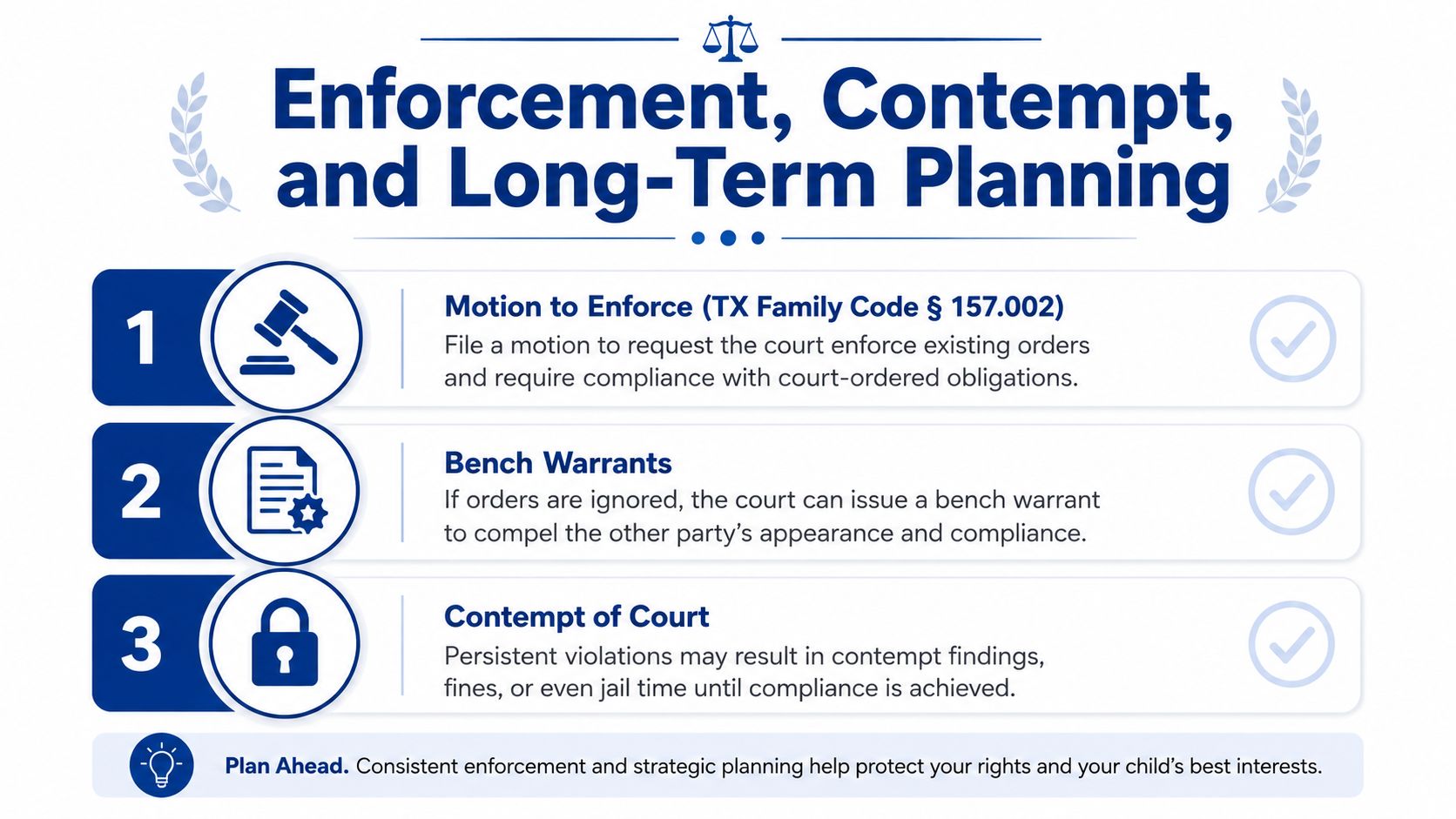
A final order doesn't end the parenting case. It gives everyone a rulebook, but the rulebook only works if both parents follow it. When one side ignores exchanges, support obligations, or other court-ordered duties, the 233rd can hear enforcement requests under Texas Family Code § 157.002 and use the tools available in family court.
What enforcement can look like
An enforcement case can involve a motion to enforce, a show-cause hearing, or contempt proceedings. If a parent doesn't appear, the court can use bench-warrant procedures where appropriate. For unpaid support, enforcement may also involve a writ of withholding or other collection tools. When the state's license-suspension procedures are in play, the request is handled through the appropriate state directory rather than by informal pressure from the other parent.
Criminal contempt and civil contempt are different. Punitive contempt has a higher proof burden, while civil contempt is aimed more at compelling compliance. Either way, the practical message is the same. The court expects orders to be followed, not debated after the fact.
Long-term planning matters too. Orders can be revisited when relocation, college-related issues, or a stepparent adoption changes the family structure. Repeated contempt findings can also affect how future custody arguments are viewed, especially when the dispute is really about reliability and follow-through. The 233rd generally expects parents to follow the standard possession order unless the evidence shows a documented reason to do something different.
A few signs it may be time to go back to court:
- Repeated missed exchanges: The order is being ignored, not just misunderstood.
- Support problems: Payments are late, partial, or absent.
- New relocation issues: A parent plans a move that affects possession.
- Safety or stability concerns: New facts have changed the child's daily routine.
- Documented pattern problems: A parenting journal or calendar shows a continuing issue that the court should see.
Keep that journal simple, factual, and dated. Judges care far more about a steady record of what happened than about a parent's anger in the moment.
If you're dealing with a custody case in the 233rd District Court, the Law Office of Bryan Fagan PLLC can help you understand the local filing path, temporary orders, mediation, and enforcement issues that come up in Tarrant County family court. If you're ready to take the next step, visit Law Office of Bryan Fagan PLLC to learn more about your options and what to do before your first court date.
